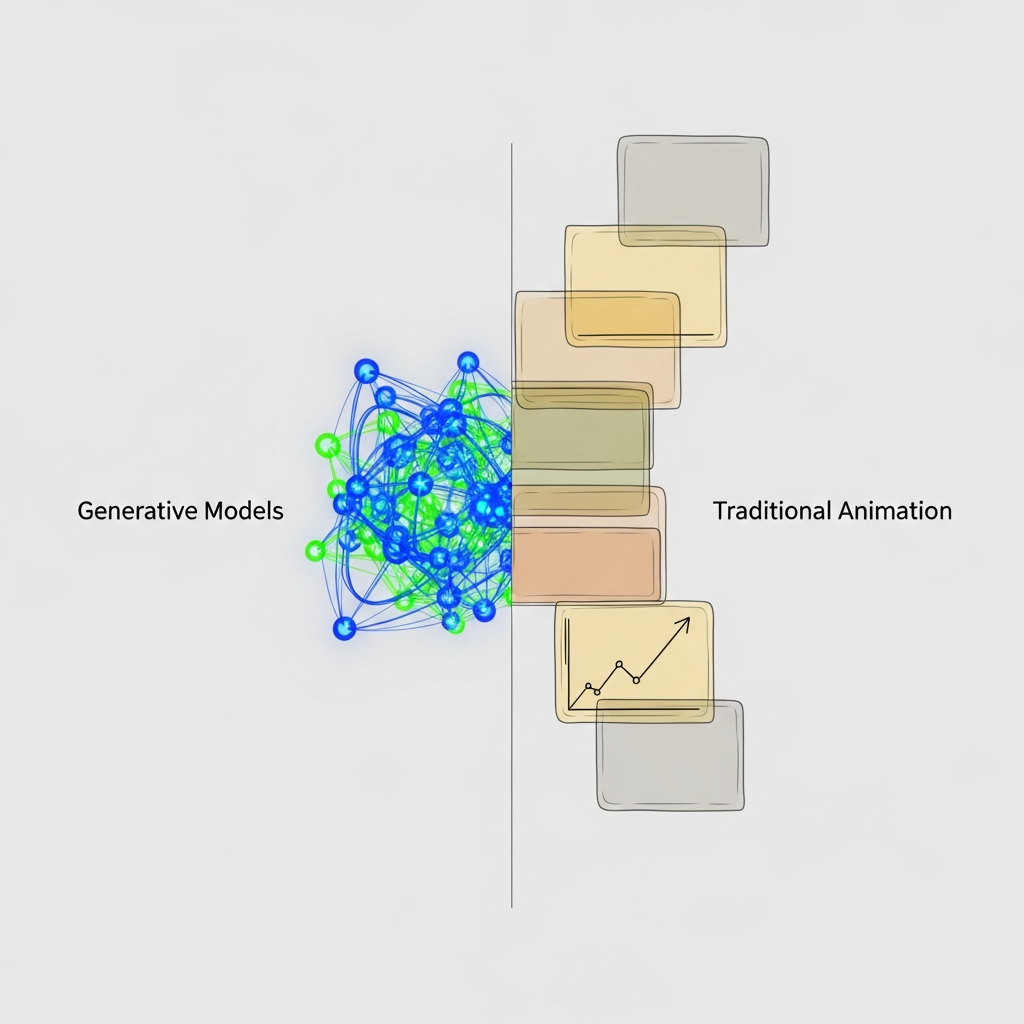
How AI model training is reshaping production workflows for data-driven financial content creators
Compare generative models against legacy animation methods for financial storytelling. Learn which approach delivers better speed, accuracy, and cost efficiency for your market commentary and data visualizations.
TL;DR
Speed advantage goes to AI - Generative models produce After Effects-quality animations in minutes versus days for traditional workflows, critical for time-sensitive financial content.
Data accuracy improves with automation - Direct data integration eliminates manual transcription errors, reducing risk in financial visualizations where wrong numbers damage credibility.
Cost difference is substantial - AI animation costs $50-200 per video versus $500-5,000+ for traditional methods, making professional visuals accessible to smaller teams.
Traditional wins for custom creative - If you need highly distinctive branded visuals or experimental motion design, After Effects still offers unmatched control.
Choose based on publishing cadence - Weekly or faster content production favors AI tools; quarterly flagship reports may justify traditional investment.
The Financial Animation Decision: What's Actually at Stake
Finance content creators face a persistent tension. You need visuals that match the precision of your data, but traditional animation workflows demand weeks of production time and specialized software expertise. The choice between high-fidelity animation and legacy methods isn't just about aesthetics. It determines how quickly you can respond to market movements, how accurately you can represent complex datasets, and whether your audience actually understands your analysis.
This comparison examines how generative models stack up against traditional animation pipelines for financial storytelling. We'll focus on production speed, data accuracy, visual quality, and total cost of ownership. If you're producing market commentary, earnings breakdowns, or economic explainers, this analysis will help you choose the right approach for your workflow.
Quick Verdict: Which Approach Fits Your Workflow
Choose AI-powered animation if you need to produce data-driven visuals weekly or faster, work without dedicated motion designers, or require real-time updates when figures change. Choose traditional methods if you have an established After Effects team, produce fewer than two videos monthly, or need highly custom creative direction that deviates from templated approaches.
For most finance content creators operating on tight publishing schedules, AI model training applied to animation represents a significant efficiency gain. The technology has matured enough that quality concerns no longer justify the time penalty of manual keyframing.
Criterion | AI Animation | Traditional Methods | Winner |
|---|---|---|---|
Production Speed | Minutes to hours | Days to weeks | AI Animation |
Data Accuracy | Automated from source | Manual input prone to errors | AI Animation |
Visual Customization | Template-based flexibility | Unlimited creative control | Traditional |
Cost per Video | $50-200 (software) | $500-5,000+ (labor) | AI Animation |
Learning Curve | Hours | Months to years | AI Animation |
Scalability | High (batch processing) | Linear with headcount | AI Animation |
Evaluation Criteria: What Matters for Financial Content
Not all animation needs are equal. Financial storytelling demands specific capabilities that general-purpose tools often overlook. We've weighted these criteria based on what finance content creators consistently prioritize.
Primary Factors
Data integrity: Can the tool pull directly from datasets without manual re-entry? Errors in financial visuals damage credibility instantly.
Production velocity: Markets move fast. A tool that takes two weeks to produce a chart animation misses the news cycle entirely.
Visual fidelity: Audiences expect broadcast-quality graphics. Amateur-looking charts undermine even the best analysis.
Secondary Factors
Total cost: Factor in software, labor, revisions, and opportunity cost of delayed publishing.
Skill requirements: Does your team need After Effects expertise, or can analysts produce visuals directly?
Update flexibility: When Q3 numbers change, how quickly can you regenerate the animation?
Head-to-Head Breakdown
Production Speed
AI Animation: Generative models compress the animation pipeline dramatically. What previously required storyboarding, keyframing, and rendering now happens through automated processes. Tools like Flowi generate After Effects-quality chart animations in minutes by applying pre-trained motion patterns to your data. You input figures, select a style, and export. The bottleneck shifts from production to ideation.
Traditional Methods:Adobe After Effects remains the industry standard, but even experienced motion designers need 4-8 hours for a polished 30-second data visualization. Factor in client revisions, rendering time, and the coordination overhead of working with external contractors. A single earnings recap video can consume a week of calendar time.
Verdict: AI animation wins decisively for time-sensitive content. If your publishing cadence is weekly or faster, traditional workflows simply cannot keep pace without significant team expansion.
Data Accuracy and Integrity
AI Animation: The strongest advantage of AI-driven tools is direct data integration. When you connect a spreadsheet or API to an animation generator, the numbers flow through without manual transcription. This eliminates the most common source of errors in financial visuals: human re-entry mistakes. Some platforms also flag anomalies, catching potential data issues before they reach your audience.
Traditional Methods: Manual workflows introduce risk at every handoff. An analyst exports data, a designer imports it, values get typed into text layers. According to industry research, this friction explains why many finance teams avoid animation entirely, defaulting to static charts despite lower engagement.
Verdict: AI animation reduces error vectors significantly. For content where a single wrong number damages your reputation, automated data pipelines provide meaningful risk reduction.
Visual Quality and Fidelity
AI Animation: Early AI animation tools produced obviously templated output. Current generative models have closed much of this gap. High-fidelity animation from AI systems now includes smooth easing curves, professional color grading, and motion blur that matches broadcast standards. The limitation is creative ceiling: you're working within the boundaries of what the model was trained to produce.
Traditional Methods: After Effects offers unlimited creative control. A skilled motion designer can create entirely custom visual languages, experimental transitions, and branded elements that no template can replicate. For flagship content where visual distinction matters, traditional tools remain superior. 93% of marketers report video marketing has delivered good ROI, and premium production quality contributes to that performance.
Verdict: Traditional methods win for creative differentiation. AI animation wins for consistent, professional-grade output at scale. Most finance content benefits more from consistency than creative experimentation.
Cost Structure
AI Animation: Subscription-based AI tools typically cost $50-300 monthly for unlimited or high-volume usage. The real savings come from labor reduction. An analyst can produce their own visuals without involving a design team, eliminating contractor fees and internal handoff delays. 11% of marketers cite animation as a budget-friendly tool compared to live-action, and AI pushes costs lower still.
Traditional Methods: Freelance motion designers charge $75-200 per hour. A single 60-second financial explainer might require 15-30 hours of work, translating to $1,125-6,000 per video. In-house teams reduce per-video costs but add fixed overhead. One VFX scene can eliminate significant production expenses, but only if you have the expertise to execute it.
Verdict: AI animation offers dramatically lower cost per video, especially for teams producing content regularly. Traditional methods become cost-competitive only at very low volumes with existing in-house talent.
Learning Curve and Accessibility
AI Animation: Most AI animation platforms target non-designers explicitly. Onboarding takes hours, not months. This accessibility means analysts and journalists can produce visuals directly, reducing dependency on specialized roles. The tradeoff is less granular control over output.
Traditional Methods: After Effects proficiency requires significant investment. Adobe's own training resources estimate months of practice for intermediate competency. This creates organizational bottlenecks where design capacity limits publishing velocity.
Verdict: AI animation democratizes production. If your goal is enabling more team members to create visuals, AI tools provide faster paths to capability.
Scalability
AI Animation: Batch processing and templated workflows enable AI tools to scale linearly with content volume. Producing 10 videos requires roughly 10x the time of producing one, not 10x the coordination overhead. This matters for teams covering multiple markets, sectors, or data releases simultaneously.
Traditional Methods: Scaling traditional animation requires proportional headcount increases. Each additional video needs designer hours. The global 3D animation market is projected to reach $40 billion by 2028, driven partly by demand that traditional workflows struggle to meet.
Verdict: AI animation scales more efficiently. For high-volume producers, this advantage compounds significantly over time.
Use Case Mapping: Which Approach Fits Your Situation
If you publish daily market commentary, choose AI animation. The speed advantage is non-negotiable. Traditional workflows cannot deliver same-day turnaround on animated content without unsustainable team sizes.
If you produce quarterly flagship reports, consider traditional methods. Lower volume justifies higher per-video investment, and the extended timeline allows for creative polish that distinguishes premium content.
If you're a solo creator or small team, choose AI animation. Without dedicated design resources, traditional tools create skill gaps that block production entirely. 73% of video marketers have created explainer videos, and AI tools make this accessible to individuals.
If you need highly custom branded visuals, traditional methods offer more flexibility. AI tools work within trained parameters; bespoke creative direction requires manual control.
If data accuracy is paramount, choose AI animation with direct data integration. Eliminating manual transcription reduces error risk measurably.
What Both Approaches Get Wrong
Neither AI nor traditional animation solves the fundamental challenge of narrative structure. A beautifully animated chart still fails if it doesn't support a clear analytical point. Both approaches require you to know what story your data tells before you visualize it.
Additionally, both struggle with real-time interactivity. Animation produces fixed outputs. If your audience needs to explore data dynamically, neither approach delivers true interactive visualization without additional tooling.
Migration and Switching Considerations
Switching from traditional to AI: The transition is relatively smooth. Existing brand guidelines can inform template customization. The main adjustment is psychological: designers accustomed to granular control may resist automated workflows initially. Plan for a 2-4 week adoption period where teams learn to work within AI constraints.
Switching from AI to traditional: This path is harder. If you've built workflows around AI speed, returning to multi-day production cycles disrupts publishing schedules significantly. Teams often underestimate how much their content strategy has adapted to faster turnaround.
Lock-in factors: AI platforms vary in export flexibility. Ensure your chosen tool outputs standard formats (MP4, MOV) rather than proprietary files. Flowi and similar tools export industry-standard formats, minimizing lock-in risk.
When switching makes sense: If your current approach consistently misses deadlines, produces errors, or costs more than 15% of your content budget, evaluate alternatives seriously.
Final Recommendation
For most finance content creators, AI-powered animation represents the practical choice today. The technology has matured past early limitations. 64.9% of marketers see moderate or significant positive impact on KPIs after incorporating animations, and AI tools make that impact accessible without design team expansion.
Traditional methods retain value for flagship content, highly custom creative needs, and teams with existing motion design expertise. But as a default approach for regular financial content production, AI animation delivers better economics, faster turnaround, and comparable quality.
The question isn't whether AI animation is good enough. It's whether traditional workflows can justify their time and cost premiums for your specific publishing needs. For weekly content producers, the answer is increasingly clear: they cannot.
Frequently Asked Questions
What is AI animation in data visualization?
AI animation uses generative models trained on motion design principles to automatically animate charts, graphs, and data visualizations. Instead of manually keyframing each element in software like After Effects, you input your data and the AI applies professional motion patterns, easing curves, and transitions. The result is broadcast-quality animation produced in minutes rather than days.
How do generative models improve financial chart animations?
Generative models learn from thousands of professional animations to understand effective motion design. When applied to financial data, they automatically determine appropriate timing for bar chart builds, line graph reveals, and number transitions. This eliminates guesswork and ensures consistent visual quality across all your content without requiring motion design expertise.
Can AI animation maintain the accuracy required for financial content?
Yes, and often more reliably than traditional methods. AI animation tools that integrate directly with data sources eliminate manual transcription errors. When your spreadsheet updates, the animation regenerates with correct figures automatically. This direct data pipeline is actually more accurate than workflows where designers manually input values into animation software.
What challenges do AI-driven animations face compared to traditional methods?
The primary limitation is creative ceiling. AI tools work within the boundaries of their training data, making highly experimental or custom visual styles difficult to achieve. Additionally, complex narrative sequences that require precise timing between multiple elements may need more manual refinement than fully automated tools provide.
When should finance content creators consider switching to AI animation?
Consider switching if you publish visual content weekly or more frequently, lack dedicated motion design resources, experience delays from design team bottlenecks, or need to update visuals quickly when data changes. The ROI becomes clear when production time drops from days to hours while maintaining professional quality standards.
How does AI model training affect animation quality over time?
AI model training continuously improves animation output as systems learn from more examples and user feedback. Modern platforms update their models regularly, meaning the quality you get today will likely improve without additional cost. This contrasts with traditional skills, which require ongoing personal investment to maintain and advance.
Sources
Read Next
Continue Exploring

7 Elements That Make Financial Animations Trustworthy
Discover the key elements of high-fidelity animation that build audience trust in financial content. Essential guide for creators who prioritize accuracy.
7 Engagement Metrics Finance Creators Must Track in 2025
Discover 7 engagement metrics that reveal what your finance audience actually wants. Learn to use data storytelling insights that drive real audience engagem...

7 Visualization Techniques That Make Data Stories Click
Discover visualization techniques that transform raw data into compelling stories. Strategic methods for finance creators to boost engagement and retention.