How to choose the right data analysis technique when your insights need to land with any audience
Learn why accurate data analysis often fails to influence decisions and when to use traditional static reports versus modern visualization methods. This comparison helps you match your approach to your audience.
TL;DR
Traditional data analysis excels at accuracy but fails at communication - 60% of project failures trace to communication breakdowns, not analytical errors
Modern visualization wins for audience comprehension and retention - Animated graphics reduce cognitive load and create stronger memory traces through dual coding
Production speed gap is closing rapidly - AI-powered tools like Flowi eliminate the technical barrier between data and professional motion graphics
Choose your approach based on audience, not habit - Technical peers need static analysis for verification; stakeholders need visual narratives for action
The cost of poor data communication is measurable - Ineffective communication costs $10,140+ per employee annually in lost productivity
The Communication Gap in Data Analysis
You have the data. You understand the patterns. Yet when you present your findings, the room goes quiet, and the insights fail to land. This scenario plays out daily across finance teams, newsrooms, and boardrooms where data analysis techniques produce accurate conclusions that never translate into action.
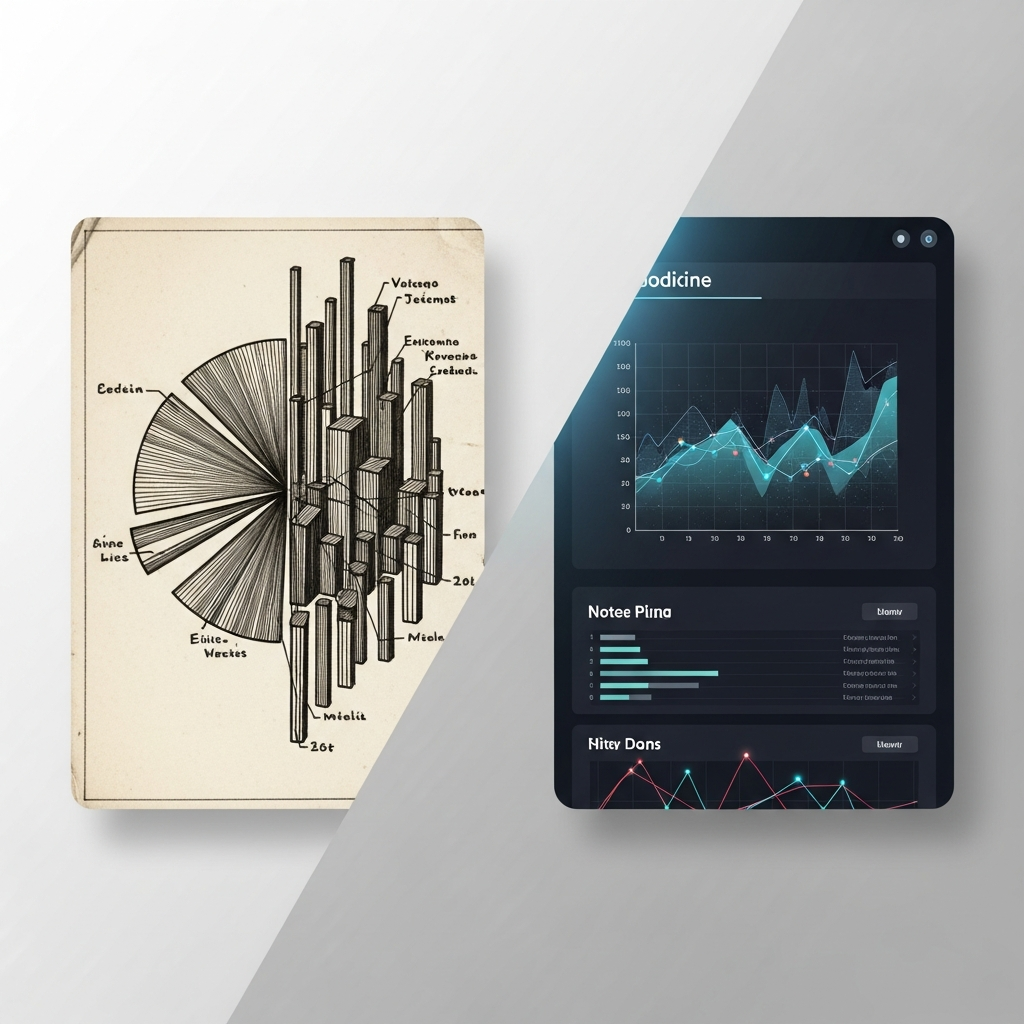
The comparison here is fundamental: traditional data analysis approaches (spreadsheets, static charts, written reports) versus modern visualization methods (animated graphics, motion-driven narratives, interactive visuals). Both can process the same underlying data. Only one consistently drives understanding and engagement.
This evaluation focuses on how each approach handles the critical handoff from analyst to audience. We examine clarity, retention, production efficiency, and stakeholder response, the metrics that determine whether your insights actually influence decisions.
Quick Verdict: Choose Based on Your Communication Goal
Choose traditional data analysis techniques if your audience consists of technical peers who will interrogate your methodology, you need maximum data density, or compliance requires specific static formats.
Choose modern visualization methods if you need to communicate insights to non-technical stakeholders, drive action from your analysis, or compete for attention in content-saturated environments.
For finance content creators and data journalists specifically, modern visualization wins decisively. Your audience measures value through engagement and shareability, not methodological rigor alone.
Criterion | Traditional Analysis | Modern Visualization | Winner |
|---|---|---|---|
Data Accuracy | High (source of truth) | High (when properly implemented) | Tie |
Audience Comprehension | Limited to data-literate viewers | Broad accessibility | Modern Visualization |
Production Speed | Fast for raw output | Historically slow, now accelerating | Context-dependent |
Engagement & Retention | Low | High | Modern Visualization |
Stakeholder Action | Requires interpretation | Drives immediate understanding | Modern Visualization |
Scalability | Easy to replicate | Requires templates or automation | Traditional Analysis |
Evaluation Criteria: What Actually Matters
We assess these approaches across six dimensions, weighted by what finance content creators and data journalists need most.
Comprehension speed matters because your audience decides within seconds whether to engage. Retention rate determines if insights stick beyond the presentation. Production efficiency affects how many stories you can tell. Accuracy preservation protects your credibility. Audience reach defines your content's impact potential. Action conversion measures whether analysis drives decisions.
For communicators competing for attention, comprehension and retention carry the heaviest weight. Technical accuracy is table stakes, not a differentiator.
Head-to-Head: Comprehension Speed
Traditional Data Analysis Techniques
Spreadsheets and static charts require cognitive effort to decode. Viewers must identify axes, interpret scales, cross-reference legends, and mentally construct the narrative. This works when your audience has time and motivation.
The limitation: 60% of project failures trace to communication breakdowns. Raw data analysis, however accurate, creates friction between insight and understanding.
Modern Visualization Methods
Animated charts and motion graphics guide the eye through data sequentially. Movement naturally directs attention, reducing cognitive load. The viewer receives the narrative structure alongside the data.
The strength here is pacing. Complex trends unfold over time rather than demanding simultaneous processing. Financial data that would overwhelm in a static chart becomes digestible when animated.
Verdict
Modern visualization wins for general audiences. Traditional methods remain appropriate when your viewers specifically need to interrogate data at their own pace.
Head-to-Head: Information Retention
Traditional Data Analysis Techniques
Static reports and charts suffer from the "forgetting curve" problem. Without narrative hooks, data points blur together. Readers remember conclusions they reached themselves but struggle to recall specific figures.
Written analysis can improve retention through strong prose, but most data reports prioritize completeness over memorability.
Modern Visualization Methods
Visual storytelling leverages dual coding, where information processed through both visual and verbal channels creates stronger memory traces. Animated sequences add temporal structure, giving the brain additional retrieval cues.
The combination of movement, color, and narrative creates what cognitive scientists call "elaborative encoding." Viewers remember not just what the data showed, but how it was revealed.
Verdict
Modern visualization significantly outperforms for retention. When 86% of workplace failures stem from communication issues, choosing the approach that sticks matters.
Head-to-Head: Production Efficiency
Traditional Data Analysis Techniques
Generating a basic chart takes minutes. Export from Excel, drop into a slide, done. The speed advantage is real and significant for internal communication or rapid iteration.
The hidden cost emerges downstream. When stakeholders misunderstand static analysis, you spend hours in follow-up meetings clarifying. Poor communication causes employees to waste 7.47 hours per week, nearly a full workday.
Modern Visualization Methods
Historically, quality motion graphics required After Effects expertise, timeline editing, and significant production time. A single animated chart could consume hours.
This landscape has shifted. Tools like Flowi automate motion graphic generation from data inputs, eliminating the technical bottleneck. What once required a designer and a day now takes an analyst and minutes.
Verdict
Context-dependent. For quick internal updates, traditional methods still win. For external content or stakeholder presentations, modern visualization's upfront investment pays off through reduced clarification cycles and higher engagement.
Head-to-Head: Accuracy Preservation
Traditional Data Analysis Techniques
Spreadsheets maintain data integrity by default. Numbers stay numbers. The risk emerges in interpretation, when viewers draw incorrect conclusions from correctly presented data.
Static charts can also mislead through poor design choices: truncated axes, cherry-picked timeframes, or confusing visual encodings.
Modern Visualization Methods
Animation introduces additional production steps where errors can enter. Each transformation from raw data to visual output creates potential for drift.
Quality visualization tools address this through direct data connections. Flowi maintains accuracy by generating graphics directly from source data, removing manual transcription errors. Domain-specific templates ensure appropriate scales and contexts.
Verdict
Tie when using proper tools. Both approaches can maintain or compromise accuracy depending on implementation. The key is reducing manual handoffs where errors multiply.
Head-to-Head: Audience Reach and Engagement
Traditional Data Analysis Techniques
Static reports and charts limit your audience to those willing to invest effort in data interpretation. On social platforms, spreadsheet screenshots generate minimal engagement. In presentations, dense slides lose attention.
The reach ceiling is built into the format. Only data-comfortable viewers will engage deeply.
Modern Visualization Methods
Motion graphics perform dramatically better across distribution channels. Video content dominates social algorithms. Animated charts capture attention in feeds designed to promote scroll-stopping content.
For finance influencers and data journalists, this reach advantage compounds. Better engagement means broader distribution means larger audience means greater impact.
Verdict
Modern visualization wins decisively for content creators. The format aligns with how platforms and audiences actually behave.
Head-to-Head: Driving Action from Insights
Traditional Data Analysis Techniques
Raw analysis presents information without prescription. Viewers must bridge the gap from "what the data shows" to "what we should do." This works when your audience has the context and authority to make that leap.
The failure mode: analysis paralysis. Ineffective communication costs employees earning $50,000 to $100,000 about $10,140 annually in lost productivity. Much of this stems from unclear handoffs between analysis and action.
Modern Visualization Methods
Visual storytelling can embed calls to action within the narrative flow. The pacing of animated reveals builds toward conclusions. Viewers arrive at the "so what" having been guided through the "why."
This narrative structure reduces the interpretation burden on your audience. They spend cognitive resources on decision-making rather than data processing.
Verdict
Modern visualization wins for communicating insights that require stakeholder action. Traditional analysis remains appropriate when the goal is enabling others to conduct their own analysis.
Use Case Mapping: When to Choose Each Approach
If you're presenting quarterly results to a board: Choose modern visualization. Board members need to grasp trends quickly and remember key points for strategic discussion. Animated charts guide attention and improve retention.
If you're sharing analysis with a technical peer for review: Choose traditional methods. Your colleague needs to verify methodology, not be persuaded. Static formats allow self-paced interrogation.
If you're creating social content about market trends: Choose modern visualization without hesitation. Engagement metrics reward motion. Static charts get scrolled past.
If you're building a compliance archive: Choose traditional methods. Regulatory requirements often specify formats. Auditability matters more than engagement.
If you're explaining complex financial concepts to general audiences: Choose modern visualization. The comprehension gap between experts and viewers is exactly what animated storytelling bridges.
What Both Approaches Get Wrong
Neither traditional analysis nor modern visualization solves the fundamental challenge of managers spending over an hour daily resolving collaboration issues. Tools improve communication efficiency, but organizational alignment requires more than better charts.
Both approaches also struggle with real-time data. Static analysis becomes stale. Animated content requires regeneration. The industry still lacks seamless solutions for live data storytelling.
Finally, both depend on analyst judgment. No visualization technique compensates for flawed analysis or misleading framing. The garbage-in-garbage-out principle applies regardless of output format.
Migration and Switching Considerations
Moving from traditional to modern visualization: The primary cost is learning curve, not financial. Analysts comfortable with Excel face a transition period when adopting motion graphic tools. However, platforms designed for data professionals (rather than video editors) minimize this friction.
Flowi specifically targets this transition by eliminating timeline editing. Analysts upload data and select templates rather than learning animation software. The skill transfer focuses on storytelling decisions, not technical execution.
When switching makes sense: If your current approach generates follow-up questions that indicate confusion rather than curiosity, the communication is failing. If stakeholders request "the simple version" of your analysis, they're signaling that your format creates barriers.
Lock-in factors: Traditional tools have minimal lock-in; Excel skills transfer everywhere. Modern visualization tools vary. Prioritize platforms that export standard formats and don't trap your content in proprietary systems.
Final Recommendation
For finance content creators and data journalists, the comparison resolves clearly. Modern visualization methods outperform traditional data analysis techniques on the metrics that matter most: audience comprehension, content retention, engagement, and action conversion.
Traditional analysis remains the foundation. You still need rigorous methodology and accurate data. But the output format, how you package insights for consumption, should leverage what we know about visual cognition and narrative structure.
The tools have caught up with the need. Generating professional motion graphics no longer requires video editing expertise. The barrier between having insights and communicating insights effectively has dropped dramatically.
Choose the approach that matches your audience and goal. For most communication scenarios facing data professionals today, that means animated, narrative-driven visualization.
Frequently Asked Questions
What is data storytelling?
Data storytelling combines data analysis with narrative structure and visual presentation to communicate insights effectively. Rather than presenting raw numbers, data storytelling guides audiences through findings using context, sequence, and visual emphasis. The goal is comprehension and action, not just information transfer.
Why is data storytelling important?
Data storytelling bridges the gap between analysis and decision-making. With 86% of workplace failures linked to communication breakdowns, the ability to translate complex data into clear narratives directly impacts business outcomes. Insights that audiences understand and remember drive better decisions than technically accurate reports that go unread.
How can I create an effective data story?
Start with a clear question your data answers. Structure your narrative with context (why this matters), tension (what the data reveals), and resolution (what to do about it). Use visuals that guide attention rather than overwhelm. Test comprehension with someone unfamiliar with your analysis before finalizing.
When should I use data storytelling instead of traditional reporting?
Use data storytelling when your audience needs to understand implications rather than verify methodology. Board presentations, client communications, and public-facing content benefit from narrative structure. Reserve traditional reporting for technical peer review, compliance documentation, and situations where viewers need to conduct their own analysis.
Which visualizations are best for data storytelling?
The best visualization depends on your data type and message. Animated line charts excel at showing trends over time. Motion bar charts work well for comparisons. The key principle: choose formats that reveal your insight progressively rather than demanding simultaneous processing of all information.
What are the key elements of a data story?
Effective data stories contain five elements: a hook that establishes relevance, context that frames the analysis, evidence presented through clear visuals, interpretation that explains significance, and a call to action that directs next steps. Each element builds toward audience understanding and response.
Sources
Read Next
Continue Exploring
7 Visualization Techniques That Make Data Stories Click
Discover visualization techniques that transform raw data into compelling stories. Strategic methods for finance creators to boost engagement and retention.

Dynamic Models vs. Traditional Charts: Which Wins?
Compare dynamic models vs. traditional charts for financial content. See which visualization method drives higher viewer engagement and fits your workflow.

Why Your Data Visualizations Fail to Drive Decisions
Beautiful charts aren't enough. Discover why narrative structure is the key to data visualization that drives decisions, not just impressions.